
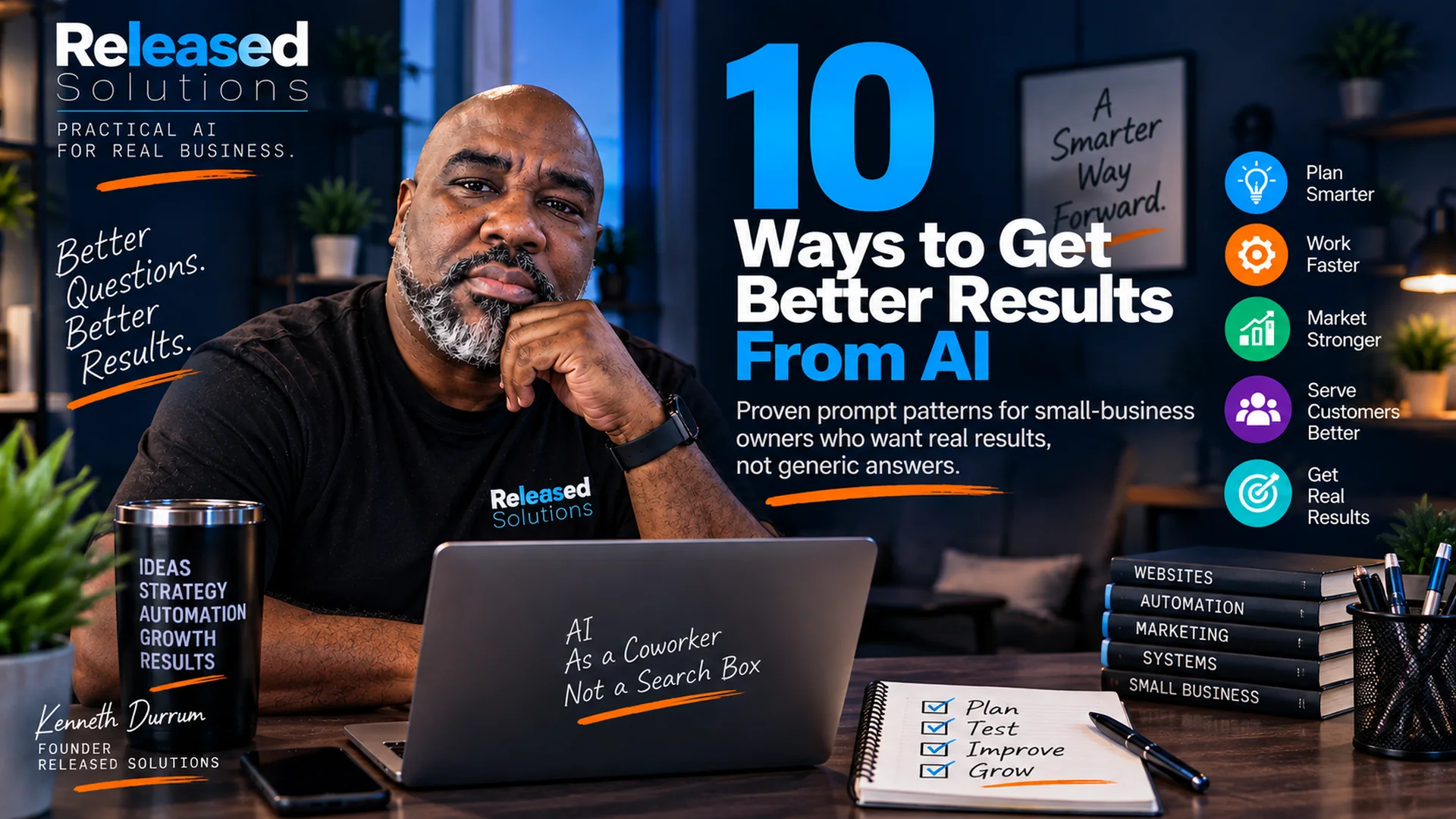

10 Ways to Get Better Results From AI: Stop Searching for the Perfect Prompt
There is a growing market for lists of "perfect AI prompts." They can be useful starting points, but they can also teach the wrong lesson.
The quality of an AI response does depend on the instructions you give it. But the goal is not to memorize a magic sentence. The goal is to communicate the assignment clearly enough that the AI understands what you are trying to accomplish, what context matters, what constraints exist and what a good result should look like.
That is why I prefer to think of AI as a coworker. I would not hand a new employee one clever sentence and expect perfect work. I would explain the job, answer questions, review the first draft, challenge weak assumptions and improve the process over time. AI works much the same way.
A GrowTechie article titled "10 AI Prompts That Unlock 100% of AI’s Potential" inspired the framework behind this article. Rather than republishing those prompts, I want to translate the underlying patterns into a practical system small-business owners can actually use.
Better AI results do not usually come from finding a magical prompt. They come from a better assignment, better context, better questions and better criteria for what "done" looks like.
A Better Way to Think About Prompting
OpenAI’s current prompting guidance reinforces several of the same fundamentals: be clear and specific, provide useful context, describe the desired output, and work iteratively. OpenAI Academy also describes prompting as something closer to giving a colleague a good assignment than discovering one perfect formula.
For a small business, that means the prompt is only the beginning. The real value comes from the conversation that follows.
Assignment, Not Spell
Stop asking "what is the perfect prompt for X?" Start asking "what would I explain to a new coworker before I asked them to do this?"
Conversation, Not Vending Machine
One prompt in, one answer out is a search box. A working conversation lets AI ask questions, propose options, challenge assumptions and refine the result.
System, Not One-Off
When a conversation produces something useful, turn it into a repeatable playbook your team can reuse next quarter, not a chat you close and forget.
10 Prompt Patterns Small-Business Owners Can Actually Use
The 10 Prompt Patterns
GIVE AI A ROLE, BUT ALSO GIVE IT A REAL JOB
Role prompting can help establish perspective, but a title by itself is not enough. Tell AI what you need the role to accomplish, who the work is for, and what constraints matter.
Instead of: "Act as a senior marketing strategist."
Better: "Act as an experienced small-business marketing strategist. Help me develop a 90-day plan to increase qualified leads for a local service business. Assume a limited budget and prioritize tactics we can realistically execute."
You want experienced perspective without settling for generic advice.
LET AI INTERVIEW YOU BEFORE IT SOLVES THE PROBLEM
If the answer depends on information AI does not have, invite it to ask for that information first. This is often more effective than trying to anticipate every detail in a giant opening prompt.
"I want help improving our lead-generation strategy. Do not recommend a plan yet. Interview me first about our customers, offers, current channels, budget, conversion process and what we have already tried. Then tell me what information is still missing."
The recommendation needs business-specific context.
TELL AI WHERE TO MEET YOU
The same explanation should not be delivered to a beginner, an experienced marketer and a developer. Tell AI what you already understand and how quickly you want the explanation to become more technical.
"I understand the basics of GA4 but I am not an analytics engineer. Explain attribution at that level. Start with the business meaning, then show me the technical details I need to make better campaign decisions."
You are learning a complex subject or entering unfamiliar territory.
ASK AI TO MAP THE SYSTEM, NOT JUST ANSWER THE QUESTION
Many business problems are connected systems. A website conversion problem can involve traffic quality, page experience, offer clarity, forms, CRM follow-up and measurement. Ask AI to show how the pieces interact.
"Break our lead-generation process into traffic, landing page, conversion, CRM, follow-up and reporting. Explain what each component does, how they depend on one another and where a failure in one stage can affect the rest."
The problem crosses multiple tools, teams or stages.
TELL AI TO CHALLENGE YOUR THINKING
Agreement feels good, but it does not always improve a decision. Ask AI to look for weak assumptions, missing evidence, contradictory logic and alternatives you may have overlooked.
"Do not assume my plan is correct. Act as a critical reviewer. Identify the three assumptions most likely to fail, what evidence would validate them, and what alternative strategy I should consider."
Before committing money, time or reputation to an idea.
ASK FOR MULTIPLE STRATEGIES AND THE TRADE-OFFS
Sometimes there is no single best answer. Ask AI to build alternatives around different priorities, then explain what you gain and sacrifice with each.
"Give me three approaches to this campaign: the fastest to launch, the most cost-conscious and the strongest long-term option. Compare expected effort, risk, measurement requirements and what we give up with each approach."
You are choosing between speed, cost, quality or long-term value.
TURN GOOD CONVERSATIONS INTO REUSABLE PLAYBOOKS
Once AI helps solve a recurring problem, do not throw away the thinking. Ask it to convert the solution into a checklist, SOP, template or workflow that your team can reuse.
"Turn the process we just used into a reusable campaign-launch playbook. Include required inputs, decision points, quality checks, owner responsibilities and a final pre-launch checklist."
You want AI to improve operations, not just produce one answer.
MAKE AI CRITIQUE ITS OWN WORK
First drafts are drafts. Give AI explicit review criteria and ask it to evaluate what it produced before you accept it.
"Review this landing-page copy for clarity, accuracy, relevance, persuasion and completeness. Score each category from 1 to 10. Identify the weakest sections and revise anything below 9, while preserving claims we can support."
The output matters enough to deserve a quality-control pass.
PUT AI IN THE CUSTOMER’S CHAIR
Marketing is not written for the person creating it. Ask AI to evaluate the message from the perspective of the intended audience and surface likely confusion, resistance and motivation.
"Review this offer from the perspective of a busy small-business owner who is skeptical of marketing agencies. What would confuse them? What would they distrust? What would make them keep reading? Rewrite the weak sections without exaggerating the promise."
For websites, ads, emails, proposals and sales material.
DEFINE WHAT "DONE" MEANS
"Make it better" is vague. A better instruction defines the success criteria. Once AI knows what the work must satisfy, it can evaluate and refine against those criteria.
"The final answer must be accurate, understandable to a nontechnical owner, under 800 words, include three practical examples, separate facts from assumptions and end with a five-step action plan. Review the draft against every criterion before returning the final version."
You need a polished deliverable and can describe what success looks like.
The Released Solutions Prompting Framework
The ten patterns can be reduced to a reusable workflow you can walk through whenever you sit down for a real working conversation with AI.
ROLE gives AI a useful perspective. CONTEXT tells it what is actually happening. QUESTIONS fill in what is missing. OPTIONS prevent premature commitment to one answer. CHALLENGE tests the thinking. CRITERIA define success. REFINE improves the result. SYSTEMIZE turns the work into something reusable.
You will not need every step for every conversation. The point is to have a better mental model for working with AI than "find the right prompt and press Enter."
If your team is still catching up on the basics before applying this framework, my note on how I use AI in real project work is a good next read.
Better Assignments
Objective, audience, constraints. The role is only part of the brief.
Working Conversations
Let AI ask what it needs, propose options and challenge the plan before it commits to one.
Explicit Criteria
Define what "done" means, then hold the draft to it before you accept the output.
Repeatable Playbooks
Turn useful conversations into checklists, SOPs and workflows the whole team can reuse.
A Prompt Is an Assignment, Not a Spell
The best AI users I see are not necessarily the people with the longest prompts. They are the people who know what they are trying to accomplish and are willing to direct the work.
Start with the objective. Give useful context. Let AI ask questions. Ask for alternatives. Challenge the answer. Define success. Refine what matters. Then save the process when you discover something worth repeating.
That is how AI becomes more than a novelty. It becomes a practical coworker.
10 Better Ways to Talk to AI: Small-Business Prompt Playbook
The ten prompt patterns, the ROLE / CONTEXT / QUESTIONS / OPTIONS / CHALLENGE / CRITERIA / REFINE / SYSTEMIZE framework and copy-paste examples in one printable PDF. Free download, no form.
Build AI Into the Way Your Business Works
Released Solutions helps small businesses use AI as a practical coworker by connecting strategy, technology, automation and repeatable processes around real business goals.
If you are trying to move from experimenting with AI to using it productively in your business, we can help you build the workflow around it.
Build a Better AI Workflow for Your Business
You do not need a longer prompt library. You need a better working framework and the operating habits to use it.
Released Solutions helps small businesses build that framework, then wire it into strategy, content, automation and reporting.
A prompt is an assignment, not a spell.
Kenneth Durrum, Released Solutions