
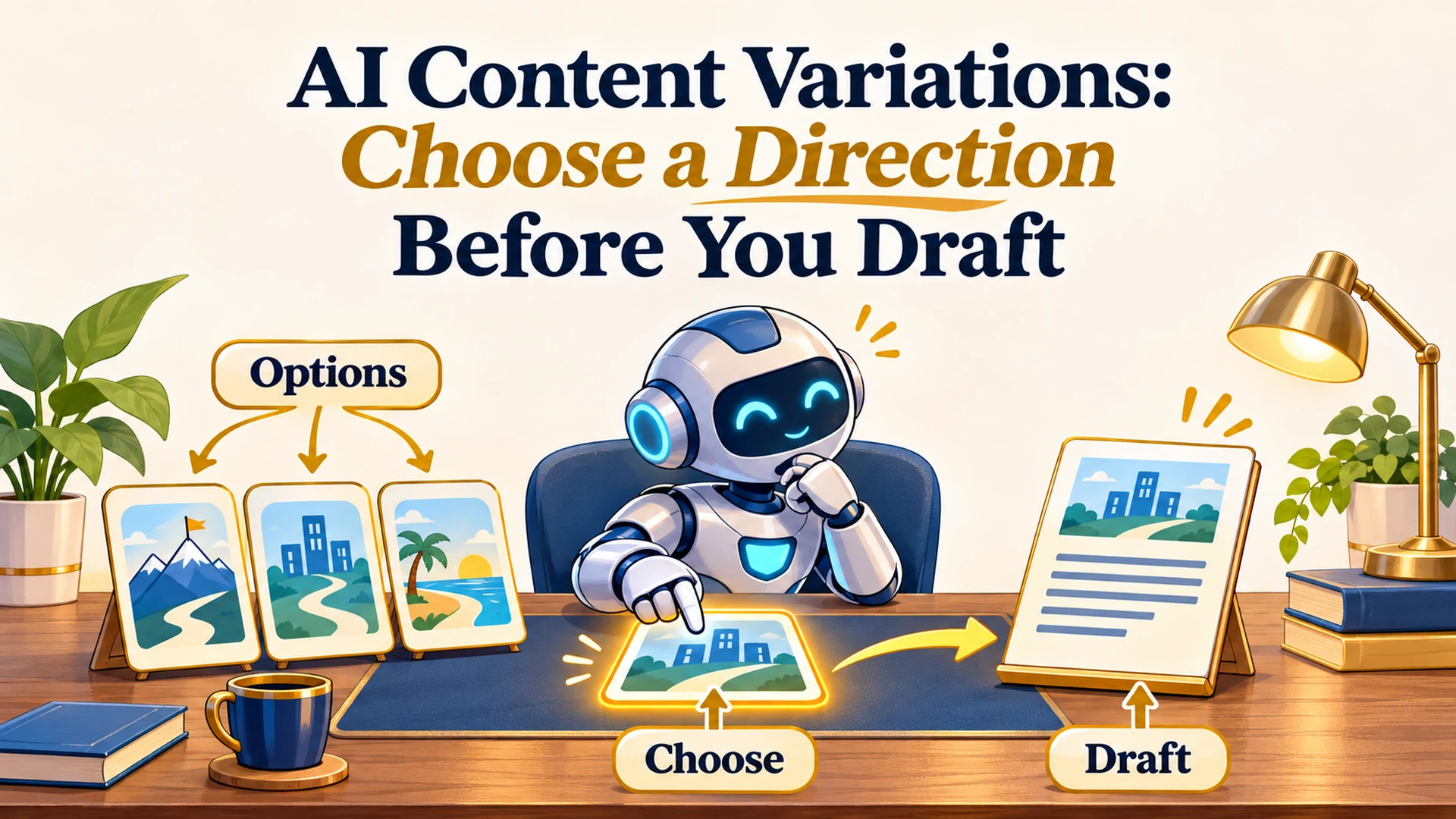

AI Content Variations: Choose a Direction Before You Draft
AI content variations are useful when they give you meaningfully different ways to communicate the same message. Ask for a few distinct approaches, compare them against the job you need the content to do, then develop the strongest direction.
That gives you an opportunity to make a decision before you spend your time polishing a complete draft.
Think about choosing a route on your GPS. You might prefer the quickest trip, fewer tolls or a road you find easier to drive. Seeing the alternatives helps because you can understand what each route offers.
You still need to know where you are going. Asking AI for more options will not solve an assignment with no clear destination.
This is Part 3 of Put AI to Work. In the previous installment, we defined the task brief. Now we are deciding which direction to develop before asking AI to finish the work.
Why Ask AI for Options Before a Full Draft?
Options let you compare the underlying ideas while they are still inexpensive to change. A headline and a short explanation can reveal a direction you want to pursue without requiring you to review several complete articles, emails or landing pages.
I ran into this while working on an email teaser. The AI draft explained the subject, but it did not make me want to read the article. My response was straightforward: “This does not excite.”
I asked for a stronger headline and teaser, a quote that could make people laugh and an analogy that would get them thinking. I was trying to give readers a reason to click through.
That experience illustrates the value of stepping back from the first wording. Sometimes you need another way into the subject before sentence-level editing becomes useful.
The AI workflow overview explains how the assignment, review and delivery fit together. Exploring options belongs before you commit to producing and reviewing the full deliverable.
What Makes AI Content Variations Meaningfully Different?
Useful variations change a decision that matters: the reader's concern, the argument, the opening scene or the way you explain the value. You should be able to describe what each option emphasizes and why you might choose it.
Consider these three requests:
- “Make this friendlier” changes the tone.
- “Give me five subject lines” explores wording.
- “Give me three different reasons this customer would care” explores the message.
All three can be useful. Choose the one that addresses the problem you are having.
If the offer is unclear, a humorous subject line may leave the same problem underneath. If the message is already strong, several concise subject lines might be exactly what you need.
My guide to better AI prompts for small business covers asking for alternatives as a general habit. Here, the focus is how to make those alternatives useful for a specific content decision.
What Should Stay the Same While You Compare Options?
Keep the audience, objective, offer and factual boundaries consistent unless changing one of them is the decision you are evaluating. Otherwise, you can end up comparing ideas built for different jobs.
For example, one version might advertise a discount to new customers while another explains a premium service to existing customers. Choosing the one you like does not tell you which message fits the original assignment.
Write down what is fixed before you ask for variations. Then name what you want AI to vary, such as the opening angle, headline approach or explanation.
Anthropic's prompting guidance recommends specific instructions about the output and its constraints. In practice, that means telling AI which part of the assignment is open for exploration.
What Does This Look Like in a Marketing Example?
Start with one business goal and ask for different approaches to that same goal. The following is a hypothetical example for a landscaping company, not a report of a client campaign or its results.
The business wants customers who signed up for its offers to request a seasonal yard-cleanup quote. The audience, service and next step stay the same across all three directions.
| Direction | Customer concern | Example opening | What to confirm |
|---|---|---|---|
| Free up the weekend | “I do not want to spend my weekend doing this.” | “What would you rather do this weekend than tackle the yard?” | The service scope and scheduling process support the convenience message. |
| Make the space usable | “The yard needs attention before we can enjoy it.” | “Ready to enjoy the yard again?” | The cleanup services match the conditions shown or described. |
| Understand the job | “I do not know what needs doing or what it will cost.” | “Start with a clear plan for your yard cleanup.” | The quote process actually explains the work and its price. |
These directions give the owner something concrete to evaluate. One emphasizes time, another emphasizes using the space, and another helps a customer understand the purchase.
None has earned a claim that it will produce more leads. They are candidate messages, and the owner still needs to check whether each one fits the customers and the service.
How Do You Ask AI for Comparable Options?
Ask for short concepts in the same format, with a clear difference between them. Include the assumptions and evidence each concept would need so you can assess more than the headline.
For the landscaping example, I would use an instruction like this:
We are preparing an email inviting existing subscribers to request a seasonal yard-cleanup quote. Keep the audience, service and call to action the same.
Give me three distinct messaging directions: one about freeing up time, one about using the outdoor space and one about understanding the work before booking.
For each direction, provide a short name, the customer concern it addresses, one opening line, the main point and any service facts we need to confirm.
Do not invent prices, availability, testimonials or performance claims. Keep each concept under 100 words. Stop after the concepts so I can select a direction before you write the email.
The word limit and three-option request are working choices for this example. They are not a formula for every project.
You can use the same approach for article angles, landing-page openings, proposal structures or visual concepts. Specify the decision you need to make, then request enough information to compare it.
How Do You Choose an Option?
Choose against the objective and the facts you can support. Your personal reaction matters, but ask whether the intended reader will understand the message, care about it and know what to do next.
I would review the options with four questions:
✓ Does this address a concern relevant to this audience?
✓ Can the business support the message with its actual service and evidence?
✓ Is the next step clear and appropriate?
✓ Can we develop this without adding claims we cannot verify?
An option with an exciting headline can still depend on an unavailable appointment, an unapproved discount or an invented customer story. Resolve those issues before developing it.
This is also where judgment protects you from AI Sloppy JOE content. Generating more material does not remove the responsibility to decide what deserves to reach your audience.
The Caveman Marketing Quiz
How much of your marketing is still hunting by hand?
Rate 15 statements and see which of five stages your marketing is in, from The Hunter to The AI-Augmented Entrepreneur.
What Should You Tell AI After Choosing?
Explain what you selected and why, then identify what to carry into the full draft. That gives AI a reason for the decision and reduces the chance that the next version loses the part you liked.
For example:
Develop the “Understand the job” direction. The useful part is helping customers feel clear about what the cleanup includes. Keep the straightforward tone, explain the next step and use only the service details I have supplied.
Write one email draft. Do not add a discount, an urgency claim or a promise about availability. End by inviting the reader to request a quote.
You can borrow an element from another concept when it serves the chosen direction. Be specific about the element, such as a shorter opening or a clearer explanation, rather than asking AI to combine every idea.
A message trying to make every argument at once can become difficult to follow. Keep the chosen purpose visible as you revise.
When Do More Options Become More Work?
More options become a burden when they repeat the same idea, require too much reading or postpone a decision you already have enough information to make. Start with a small set and ask for another round only when you can explain what is missing.
Three short concepts are my suggested starting point for a task like the example above. If all three fail, clarify the brief or identify a different concern to explore before requesting more.
Once you have a direction you can support, move into drafting. You can measure the usefulness of this step by whether it helped you make a better-informed decision with a manageable amount of review.
The goal is to choose a route and start driving. You do not need your GPS to read out every street in the county.
Does Choosing an AI Variation Count as Testing It?
No. Selecting a draft is an editorial decision. Learning how customers respond requires evidence from actual audience behavior.
AI can help you develop candidates and identify questions to investigate. Its explanation of why one message might work is a hypothesis, even when it sounds persuasive.
For email, look beyond which version you personally prefer and decide what response would matter to the business. My email marketing guide covers the larger chain from the message to the customer action.
Keep the distinction clear: a promising concept is ready for development and review. It has not yet demonstrated a business result.
Frequently Asked Questions About AI Content Variations
Should You Always Ask for Three Options?
No. Three is a manageable starting point for the worked example. A simple wording change may need two alternatives, while a broader creative assignment may justify more exploration.
Can You Ask AI to Recommend Its Favorite?
Yes. Ask it to explain its recommendation against your criteria and identify assumptions that need checking. Treat the recommendation as input to your decision, rather than evidence of customer preference.
Should Every Option Be a Complete Draft?
Usually, short concepts are enough when you are choosing a direction. Complete drafts become more useful when the direction is settled and you need to compare how it is executed.
Choose the Direction Before You Polish the Draft
Take one piece of content you are struggling with and identify the decision that is still open. Ask AI for a few short, comparable approaches, select against your objective and explain what makes the chosen direction useful.
That is the habit I want business owners to take from this installment. Give yourself room to recognize a stronger idea before spending the afternoon fixing the first one.
If you want help applying this to your own marketing, explore one-on-one marketing and AI coaching. We can work through a real assignment, compare the options and develop the direction that fits your business.
Last fact-checked: November 9, 2026.