
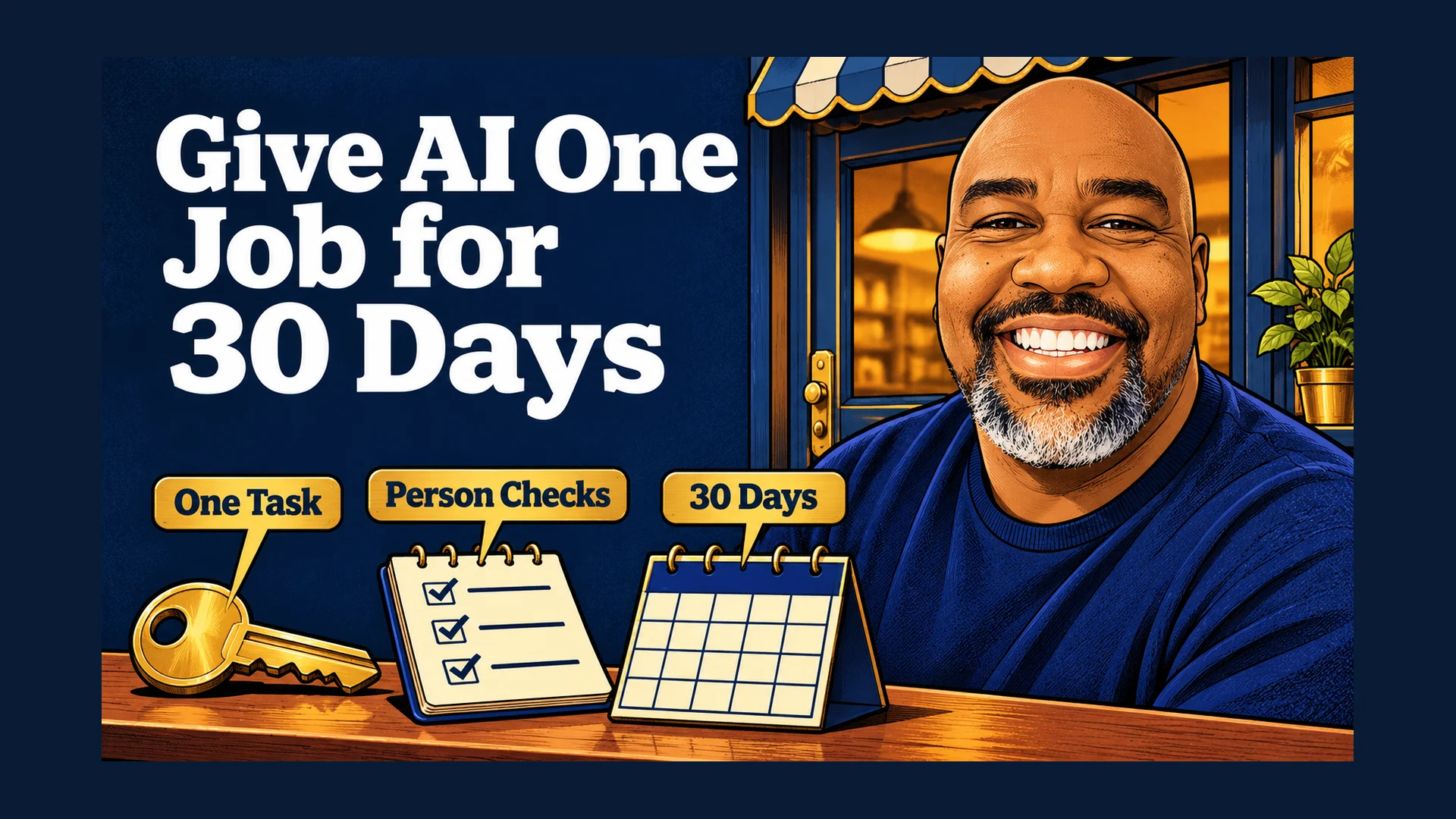

Give AI One Job for 30 Days
An AI pilot for small business owners who want to see what works before they commit.
Pick one task you already do, give AI only the information it needs, and have a person check every result. After 30 days, compare the time, cost, and quality with the way you do that job today. Then decide whether to keep it, change it, or stop.
Think about the keys to your business. You might give someone a key to open the front door without giving them one to the cash drawer. You can give an AI tool that same narrow assignment. Let it draft an answer from information on your website while your team keeps control of the inbox and decides what gets sent.
That caution is understandable. In Bluevine’s 2026 survey of 942 U.S. small business owners and financial decision-makers, 33% cited data security and privacy as a barrier to using AI more deeply, up from 23% in 2025. Another 31% cited a lack of trust in its accuracy. Both concerns can shape how you set up the trial.
What should an AI pilot for a small business start with?
Start with something that comes up often, uses information you already trust, and takes a few minutes to check. Drafting replies to routine questions about hours, parking, or what to bring to an appointment fits. You can use the answers you already publish and keep each draft in front of a person before it goes anywhere.
Pick one of those jobs and time it a few times the way you do it now. If people rarely ask the question or your saved reply already takes 20 seconds to send, pick something else. A good first task gives you enough work to measure and enough room to improve. If your team wants more practice before choosing a task, start with this roadmap for learning AI in a small business.
In my own business, I’ve used AI to turn meeting notes into follow-up drafts and action lists. I still check who agreed to do what before a follow-up goes out. Anyone who has walked out of a meeting with two different ideas of what “next Friday” means knows why that step matters.
How do you protect customer information during the trial?
Give the tool a short list of approved facts and keep real customer details out of the first trial. For a parking reply, the tool needs the parking instructions and the tone you want. It can draft a useful answer with a placeholder for the customer’s name, which your reviewer can fill in before sending.
Check your specific plan’s settings for model training, data retention, sharing, and connected apps. OpenAI’s business data policy, for example, says it excludes ChatGPT Business inputs and outputs from model training by default. Check retention and sharing separately, use a company account with two-factor authentication, and leave inbox and CRM connections off for this test. The AI privacy checklist walks through those settings in more detail.
Keep passwords, login codes, payment details, tax IDs, and confidential records out of the trial. If the task requires sensitive data, choose a different first task. Get qualified advice before moving into hiring, credit, or regulated work.
How do you catch mistakes and keep the personal touch?
Give one person responsibility for every draft that goes to a customer. They check names, dates, prices, and promises against an approved source, then read the reply as if they were the customer. If a draft makes up an answer or sounds wrong for the situation, the reviewer fixes it or writes the reply from scratch.
Tell your team exactly what you’re testing. For example, “We’re looking at how much time we spend drafting routine replies. You still decide what we say and handle the conversations that need you.” Give the reviewer a few examples to practice with and a place to record what keeps going wrong.
Leave complaints, exceptions, and delicate conversations with your team during the pilot. If you later try a customer-facing chatbot, tell people they’re speaking with an automated tool and make it easy to reach a person.
The Caveman Marketing Quiz
How much of your marketing is still hunting by hand?
Rate 15 statements and see which of five stages your marketing is in, from The Hunter to The AI-Augmented Entrepreneur.
How do you tell if AI earned its keep?
Count the time it takes to get a reply you’re willing to send. Include the time spent preparing the input, checking the draft, making corrections, and starting over when needed. Track setup time and the subscription cost, too. That gives you a fair comparison with your original process and a clearer picture of the cost of getting an AI-assisted task finished.
Suppose your team writes 20 routine replies a week. In this example, those replies used to take five minutes each and now take three minutes each, including review. You’re saving 40 minutes a week, or about two hours and 40 minutes over four weeks. Compare that with the cost of the tool, the time it took to set up, and what happened to the quality of the replies.
At day 30, make one decision.
- Keep it if the task takes less effort, the replies meet your standards, and your team can follow the rules.
- Adjust it if you can point to one fix, such as updating the FAQ or narrowing the kinds of replies the tool drafts. Test the change on the same task.
- Stop it if checking the work takes as long as doing it yourself, errors keep repeating, or the task calls for information you’re unwilling to share.
If it works, try one more task and measure that one on its own. The tool earned a key to one door. You still decide which door opens next.
Download the small business AI pilot checklist
Use the fill-in checklist to choose your first task, name the reviewer, and write down how long the job takes today. Keep it nearby so you can record what happened and make a decision at the end of the month.
Want help choosing your first task?
Bring me one job your team keeps putting off or doing by hand. In one-on-one AI coaching, we can map how you do it today and decide whether it’s a fit for a small trial.
Last fact-checked: November 26, 2026.