
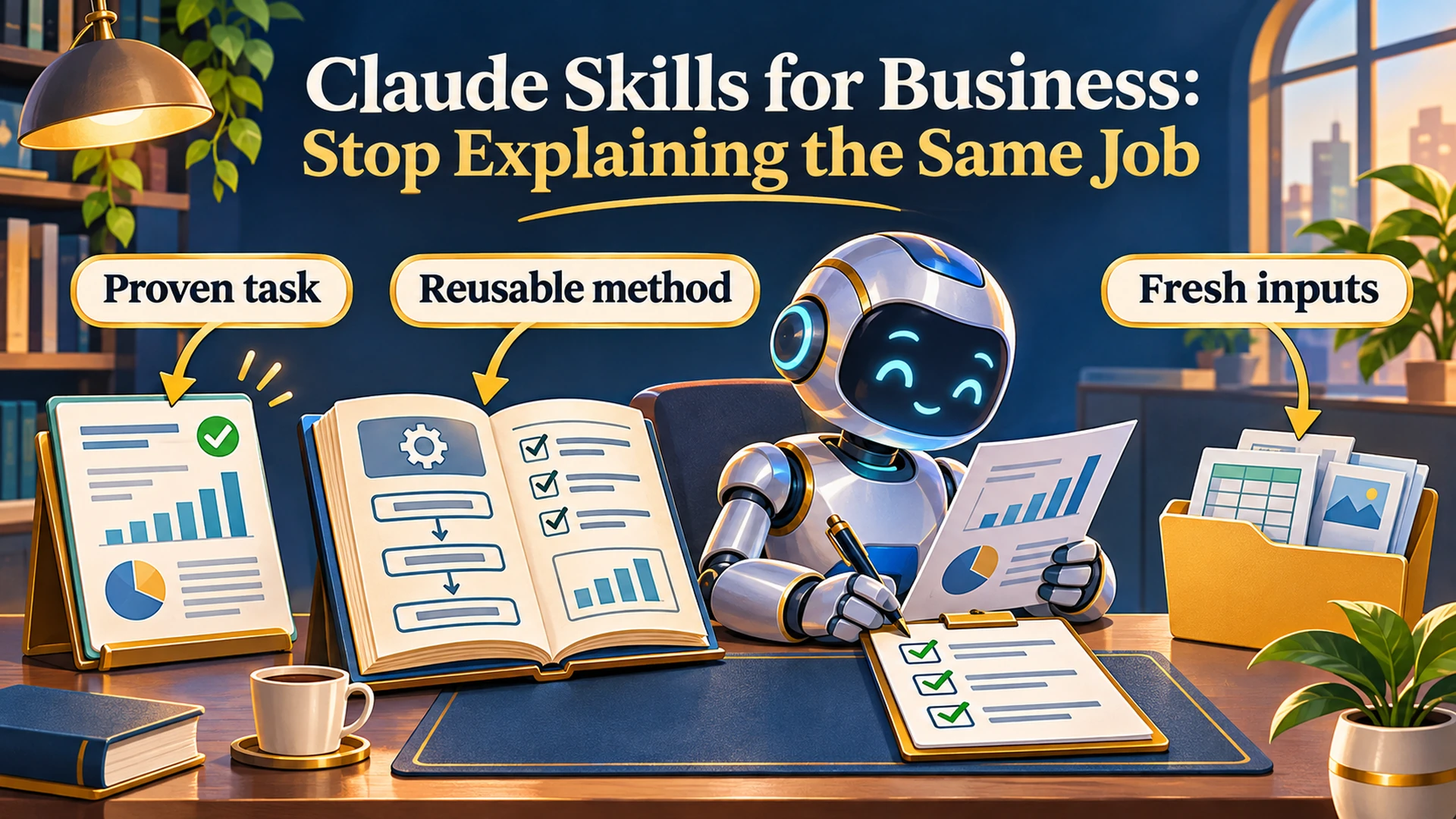

Claude Skills for Business: Stop Explaining the Same Job
Claude skills for business let you package instructions and supporting resources for tasks you perform repeatedly. Start with a process you understand and have tested, then capture how the work should be done and checked. A skill becomes useful when it reduces repeated explanation without removing the review the task needs.
Think about training someone to prepare your weekly customer report. On the first day, you explain the files, the calculations, the format and what deserves your attention.
By the fourth week, you probably want a written procedure. Otherwise, you have hired an assistant and given yourself a recurring training appointment.
AI work can reach that same point. Once you know what works, preserve the method.
This is Part 6 of Put AI to Work. We have covered defining an assignment, choosing a direction, selecting useful outputs and recovering when a conversation goes off course. Now we can turn a proven task into something reusable.
What Are Claude Skills for Business?
Claude skills are packages of instructions and resources for particular kinds of work. They can describe a procedure, provide examples and include scripts when the task needs them.
Anthropic’s explanation of how skills work describes how Claude identifies relevant skills and loads their guidance when needed. A business might use one for preparing meeting notes, following document standards or performing a defined analysis.
The business value comes from the procedure you capture. “Help with marketing” leaves most of the assignment open, while “prepare this weekly campaign review using these definitions and checks” gives the assistant a recognizable job.
A saved procedure can still be wrong or incomplete. Reusability makes testing more valuable because the same weakness can affect the next run too.
When Is a Task Ready to Become a Skill?
A task is a good candidate when it recurs, its method stays reasonably consistent and you can recognize an acceptable result. You should also understand the common exceptions well enough to explain how they should be handled.
One impressive answer gives you a starting point. Try the process with fresh inputs before deciding that the method is ready to reuse.
For a weekly report, the second run might reveal a missing column, a new campaign type or a reporting period that does not match the previous week. Those differences help you see which instructions belong in the procedure.
Ask yourself:
✓ Do I perform this task often enough to justify maintaining instructions?
✓ Can I describe its inputs and finished result?
✓ Which corrections keep coming up?
✓ Can I check the important parts?
✓ What should happen when required information is missing?
If those answers remain unclear, continue refining the task. Your AI task brief and acceptance checks are a useful place to begin.
How Does This Apply to My Publishing Process?
My article-production process contains requirements that repeat even when the subject changes. Approved words must remain intact, the production handoff needs specific fields, links need verified destinations and images need the right dimensions.
Those requirements should not depend on remembering which conversation contained the latest correction. They belong in an identifiable procedure that the next assignment can use.
The article itself changes each time. The method for packaging it has a more stable structure.
That distinction matters when capturing a skill. The reusable instruction should explain how to handle approved copy, while the current article supplies the actual words.
The same applies to your business. A proposal-preparation skill can describe the comparison process, but this week’s vendor proposals still need to be available.
How Are Skills Different From Prompts, Projects and Tools?
A prompt gives the current instruction. A skill packages a reusable method, while project context can supply background for ongoing work. Connected tools provide access or actions that instructions alone cannot perform.
Anthropic’s comparison of skills, projects and other capabilities explains how these pieces can work together. They solve related problems, but they are not interchangeable.
For a recurring customer report, the distinction could look like this:
| Component | What it provides | Example |
|---|---|---|
| Current prompt | This run’s assignment | Prepare the report for the supplied reporting period |
| Skill | The reusable procedure | Validate inputs, calculate defined measures and produce the review |
| Project context | Background for the ongoing work | Business objectives, terminology and reference material |
| Connected tool | Access to an external system | Retrieve the current records when access is configured |
| Current source files | Evidence for this run | The actual campaign export and customer records |
Writing “retrieve the latest records” in a skill does not create a connection to those records. Confirm that the required access exists, then test whether the correct information is retrieved.
Keep changing facts separate from stable procedure where practical. You want to update this month’s inputs without rewriting the entire method.
What Should You Put in Your First Skill?
Include the task’s purpose, when it applies, required inputs, procedure, output and checks. Add the exceptions that would otherwise force the assistant to guess.
Keep the first version focused on one useful job. A short procedure you understand is easier to test than an instruction manual covering every department.
For a hypothetical weekly campaign review, the core requirements might be:
When to use it: When preparing the business’s weekly advertising review from supplied campaign exports.
Required inputs: The current reporting file, reporting dates, metric definitions and any approved comparison period.
Procedure: Check the inputs, identify missing information, calculate the defined measures and separate observations from possible explanations.
Deliverable: A campaign comparison table, a short summary and questions that require the owner’s attention.
Acceptance checks: Figures agree with the source, periods are consistent and unsupported sales or profitability claims are absent.
Exceptions: Flag missing fields, mismatched periods and calculations the available data cannot support.
Those requirements describe the method. They do not establish that a finished skill exists or that it has passed a test.
The output format you choose for AI work belongs in that method too. Specify what the recipient needs to review and use.
The Caveman Marketing Quiz
How much of your marketing is still hunting by hand?
Rate 15 statements and see which of five stages your marketing is in, from The Hunter to The AI-Augmented Entrepreneur.
How Do You Turn a Successful Conversation Into a Skill?
Extract the instructions that produced acceptable work, remove obsolete attempts and organize the result around the recurring task. Then review the proposed skill before installing or depending on it.
You can ask Claude to help capture the procedure. Give it the successful example and explain which qualities should repeat.
For example:
Review the completed task and the corrections that led to the accepted result. Propose a reusable skill for preparing this type of report.
Separate the stable procedure from facts specific to this reporting period. Identify the required inputs, output format, acceptance checks and known exceptions.
Preserve the rule that observations must be supported by supplied records. Do not add permissions, integrations or business rules we have not established.
Show me the proposed instructions and supporting resources for review. Identify anything that still needs a decision or a test.
Claude’s Agent Skills format uses a SKILL.md instruction file, with supporting resources where needed. Anthropic’s introduction to Agent Skills explains that structure and describes capturing successful approaches into reusable guidance.
You do not need to write a script for every skill. Begin with clear instructions, then add code when there is a specific operation worth making more consistent.
How Do You Test Whether the Skill Works?
Test it on fresh inputs and compare the output with the same acceptance checks you would use manually. Include an ordinary case, a common exception and a request outside its intended scope.
The ordinary case shows whether it can perform the job. The exception shows whether it recognizes missing information, and the unrelated request helps reveal whether its description is too broad.
For the hypothetical report:
✓ Supply a complete current export and check every displayed figure.
✓ Supply an export missing a required field and check that the gap is reported.
✓ Supply mismatched reporting dates and check that the comparison is questioned.
✓ Ask for unrelated creative work and check that the reporting procedure does not distort the assignment.
Record what happened and revise the instructions where the result exposed a problem. Then retest the affected behavior.
A skill that produces the expected format while inventing missing figures has failed the important part of the test.
What Should You Avoid Putting in a Skill?
Avoid outdated decisions, unrelated instructions and changing facts that should come from current sources. Also avoid including secrets or treating the skill as permission to take actions beyond the assignment.
A procedure can specify the boundaries of a task. It cannot supply an unavailable account connection or make an unsupported claim accurate.
Be careful with instructions that hide uncertainty. “Always return a completed report” can encourage an apparently finished result when a required input is missing.
“Identify what is missing and explain which parts cannot be completed” gives the assistant a useful way to handle that situation.
When the work changes, update the relevant instructions and test them again. A procedure for last year’s business may still run successfully while producing the wrong result for today’s business.
Frequently Asked Questions About Claude Skills
Do I Need a Skill for Every Task?
No. A direct prompt may be enough for occasional or simple work. Consider a skill when the same method, corrections or output requirements recur often enough to maintain.
Does a Skill Make the Work Automatic?
A skill provides reusable guidance. Running on a schedule, accessing another system and delivering a result depend on the surrounding tools and setup.
Will a Skill Always Produce the Same Result?
Do not assume it will. Inputs, available tools and model behavior can affect the result. Retain the checks needed to decide whether the work is acceptable.
Capture the Method That Worked
Choose one recurring task that already produces a result you can evaluate. Write down the procedure, preserve an acceptable example and test the next run with fresh information.
That is how the skill earns its place in your repeatable AI workflow for small business. It carries useful instructions forward while you remain responsible for judging the work.
Your assistant should not need the same first-day orientation every Monday. Give it a procedure worth following, then check that it follows it.
If you want help turning a recurring task into a reusable process, explore practical marketing and AI coaching. We can work through an actual assignment, identify what should repeat and define how the result will be checked.
Last fact-checked: November 9, 2026.