
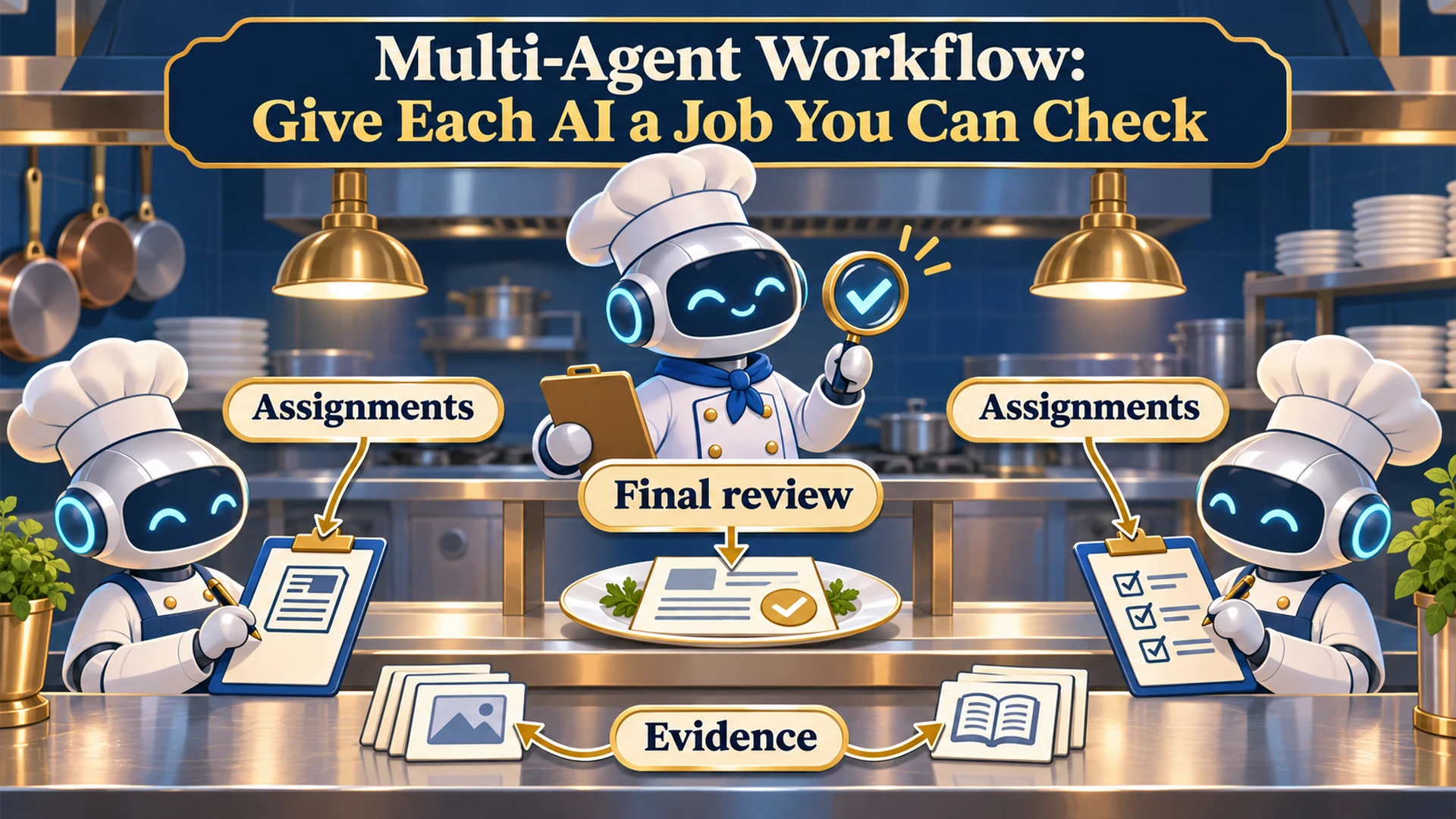

Multi-Agent Workflow: Give Each AI a Job You Can Check
A multi-agent workflow is useful when a larger assignment contains separate jobs that AI workers can handle with clear inputs, boundaries and acceptance checks. Give one coordinator responsibility for combining their findings, resolving conflicts and handing back the finished result.
Think about a restaurant kitchen. Different cooks can prepare different parts of a meal, but someone still needs to check what reaches the pass before it goes to the table.
Three cooks seasoning the same soup is also a team. It just may not be a good dinner.
This is Part 10, the final installment of Put AI to Work. We have worked through the assignment, options, outputs, recovery, reusable methods, business knowledge, maintenance and cost. Now we can decide when a larger job deserves a team.
What Is a Multi-Agent Workflow?
A multi-agent workflow divides an assignment among multiple AI workers and coordinates their results. Each worker needs a defined responsibility, while the overall process needs a way to preserve evidence, manage dependencies and decide whether the combined output meets the assignment.
A coordinator may be an AI agent operating within a configured system. You can also apply the same management principles when you coordinate separate AI conversations yourself.
Those arrangements do not have identical capabilities. Opening several chats does not automatically give them shared files, current decisions or a way to communicate.
Anthropic’s guide to Claude Code subagents describes specialized assistants working in their own context windows and returning results. The exact tools, permissions and coordination features depend on the environment you use.
When Does a Task Deserve More Than One Agent?
Consider multiple agents when parts of the work can proceed independently and produce outputs that someone can check and combine. Keep a single workflow when the job is small, tightly connected or likely to require constant clarification from you.
Useful candidates might include reviewing separate document collections, investigating distinct questions or checking different aspects of an existing deliverable. Each assignment should have a reason to exist beyond keeping another agent busy.
Before dividing the work, ask:
✓ Can I explain each worker’s job without describing the whole project again?
✓ Does each worker have the sources and access its job requires?
✓ Can the jobs proceed without continually waiting for each other?
✓ Will the returned results fit together in a useful format?
✓ Who checks the finished result?
Anthropic’s guidance on building effective agents recommends starting with the simplest solution that meets the need. Added complexity has to earn its place through the results.
Start with the business workflow and its finish line. Add workers where the assignment benefits from a clear division of labor.
What Does This Look Like in My Publishing Process?
My publishing process separates writing and editorial approval from building and publishing. The production handoff carries approved copy, publishing fields, verified destinations, image requirements and instructions for the builder.
I still decide whether the article says what I want it to say. The builder receives the approved words and the requirements for turning them into the live page.
That handoff makes responsibilities concrete. The article’s final words should not depend on the builder reconstructing what somebody meant in an earlier conversation.
The same principle applies when several AI workers contribute to an assignment. Define what each one supplies and what the next person or system is entitled to rely on.
How Could You Divide a Business Review?
Divide the review by distinct questions and source collections, then give the coordinator a common output format. Keep the findings tied to evidence so the combined recommendation can be checked without rerunning every investigation.
Here is a hypothetical review of a small business’s marketing. The workers use approved snapshots or exports supplied for the assignment, with access limited to the material they need.
| Role | Assignment | Evidence returned | Boundary |
|---|---|---|---|
| Website reviewer | Check the supplied service pages and inquiry path for clarity | Page or screenshot reference beside each finding | Do not edit the website |
| Customer-feedback reviewer | Identify recurring themes in the supplied feedback | Record references, examples and limits of the collection | Do not infer every customer shares a view |
| Campaign reviewer | Examine the supplied campaign results against the stated goal | Source fields, reporting period and calculation steps | Do not change campaigns or spending |
| Coordinator | Combine findings into one prioritized review | Sources, unresolved conflicts and acceptance-check results | Do not turn assumptions into established facts |
The website reviewer can start without waiting for the feedback reviewer. But a recommendation about why inquiries are low may depend on all three investigations.
That recommendation belongs in the combined review. A worker who sees only one part of the business should label the limits of its conclusion.
What Should Every Agent Assignment Include?
Give each worker the question to answer, the relevant sources, permitted actions and the required output. Include acceptance checks and a stop condition so the worker knows when to return a result or explain a blocker.
Use the same discipline as an AI task brief with acceptance checks, narrowed to the worker’s part of the job.
For each assignment, specify:
✓ Objective: the question this worker must answer.
✓ Inputs: exact files, versions, dates or approved locations.
✓ Scope: what belongs to this worker and what another worker owns.
✓ Permissions: what it may read, create or change.
✓ Output: the format and destination of its findings.
✓ Evidence: how findings must point back to their sources.
✓ Stop rule: what to do when access, information or authority is missing.
Anthropic’s account of building its multi-agent research system describes the importance of clear objectives, output formats, source guidance and task boundaries. Vague delegation can produce duplicated work and gaps.
“Look into the marketing” leaves a lot to interpretation. “Review these service-page snapshots for unanswered buying questions, return a finding table with page references and make no edits” gives you something you can inspect.
What Must the Coordinator Do?
The coordinator owns coverage, dependencies and the combined deliverable. It checks whether every required assignment returned usable evidence, identifies contradictions and makes unresolved gaps visible before presenting the result as complete.
I would expect the coordinator to:
Match the assignment’s requirements to named workers.
Confirm each worker has the needed inputs and boundaries.
Track work as pending, complete or blocked.
Check returned findings against their sources.
Resolve duplication and investigate conflicts.
Apply the acceptance checks to the combined result.
If one worker cannot access campaign data, the coordinator should report that gap. It should not quietly substitute a confident opinion about advertising performance.
One complete-looking report can hide an incomplete investigation. Require the coordinator to account for missing work as clearly as completed work.
The Caveman Marketing Quiz
How much of your marketing is still hunting by hand?
Rate 15 statements and see which of five stages your marketing is in, from The Hunter to The AI-Augmented Entrepreneur.
Can Separate Agents Work on the Same Files?
They can in some environments, but shared access needs a clear ownership plan. Give workers separate outputs where possible and designate who may update the final document so simultaneous changes do not overwrite decisions or obscure which version governs.
For the hypothetical marketing review, each worker could return a separate findings file. The coordinator then builds one combined report from those records.
Provide the exact input and output locations in each assignment. Verify that the worker can access them rather than assuming everything visible in your main conversation is visible everywhere else.
Permissions also need to match the assignment. A worker reviewing an export does not need the authority to alter the live campaign behind it.
My guide to giving agentic AI appropriate independence covers the broader question of access and responsibility. Delegation should preserve those boundaries.
Does Agreement Between Agents Prove a Finding?
No. Agreement is useful only alongside the evidence and the checks performed. Several workers can repeat the same mistaken source, share an incorrect assumption or overlook the same missing information.
If a reviewer is meant to provide another check, give it the original requirements and the sources needed to evaluate the work. Ask it to identify unsupported findings, calculation errors and missing requirements.
Check which source each reviewer used. Two summaries of one unsupported claim do not become two independent pieces of evidence.
Keep verification of AI-generated work attached to the actual conclusion. An extra agent is an additional review opportunity, not a guarantee that the conclusion is right.
How Do You Know Whether the Team Helped?
Compare the coordinated workflow with a simpler approach using the same assignments and acceptance checks. Include worker usage, coordination, retries and human review, then assess whether the finished work improves enough to justify the added effort.
Parallel work may shorten the wait for separate investigations. It can also add duplicated searches, repeated context and time spent reconciling results.
Record the time until an accepted result, the work needed to correct it and the quality gaps that remain. A team that finishes its individual assignments quickly can still leave you with a slow afternoon assembling the answer.
If one worker repeatedly duplicates another, revise the boundaries. If every worker must wait for the previous one, a sequential process may be easier to manage.
You can also use ordinary automation for predictable steps. Copying a finished file to its destination does not always need another reasoning agent.
A Prompt for Planning the Team Before Running It
Ask for a delegation plan before launching workers or changing business systems. The plan should explain why each worker is needed, what it will return and which parts of the job must remain sequential.
You could adapt this prompt:
Review this assignment and propose the smallest useful division of work. Explain whether one assistant is sufficient or separate workers would help.
For each proposed worker, state its objective, exact inputs, permitted tools and actions, output format, evidence requirements and stop condition. Identify dependencies and anything the coordinator must resolve.
Define the acceptance checks for the combined result and the time or spending boundaries that must be enforced in the available system. Do not assume a written limit is an enforced control.
Return the plan for review before starting workers, changing files, sending messages or publishing anything. If the available environment cannot support the proposed coordination, explain the limitation.
Once the plan is settled, run a bounded test on work you can review. Keep the arrangement small enough that you can understand where the result came from.
Frequently Asked Questions About Multi-Agent Workflows
Are Multiple Chats the Same as a Coordinated Agent Team?
No. Separate chats may help divide your attention, but coordination still requires current instructions, accessible inputs, clear handoffs and someone combining the results. Check which of those capabilities your environment provides.
You may be doing the coordination yourself. Include that work when judging whether the arrangement helps.
Should Every Worker Use a Different Model?
Choose a model that can meet the worker’s requirements within the available budget. Different models are an option, not a requirement for a useful team.
Test the assignments before deciding. A cheaper worker that repeatedly needs repair can increase the cost of the whole job.
How Many Agents Should You Use?
Use the smallest team that handles the meaningful independent parts of the assignment. There is no useful universal count based only on the number of documents or the apparent size of a project.
Add a worker when its responsibility is distinct and its contribution can be checked. Reduce the team when coordination costs more than it contributes.
Put the Whole Workflow to Work
Choose one business assignment you already understand. Define the finish line, identify any independent parts and decide who will check the combined result before expanding the setup.
The kitchen earns its reputation through the meal that reaches the customer. Your AI workflow needs the same attention to the finished result, whether one assistant or several helped prepare it.
That is the purpose of Put AI to Work: give the technology a useful assignment, provide what it needs and keep responsibility for the outcome. You can return to any installment as the process develops.
If you want help deciding how to organize AI around your own business work, explore AI coaching for practical business workflows. We can start with one assignment and decide what should be handled by a person, a repeatable process or a coordinated team.
Last fact-checked: November 10, 2026.